

Comments can be marked as an Answer, like on StackOverflow.
Was anything changed about how this federates? If no, what protections are in place against someone just patching their instance software to always return an "answer": true on Notes?


Comments can be marked as an Answer, like on StackOverflow.
Was anything changed about how this federates? If no, what protections are in place against someone just patching their instance software to always return an "answer": true on Notes?


This could just be one sed command:
echo $line | sed -E 's/TH|[EL ]|DO//g'


Earlier this week, I announced the immediate availability of a reference implementation for the Public Key Directory–a project I’ve been working on since June 2024. Hundreds of people shared it on Mastodon and BlueSky. Comparatively, almost nobody on Hacker News ever saw it.
I’ll admit I missed this despite it being posted in !technology@lemmy.world. Lumping Masto and Bluesky together here is weird though given the Masto post got 300+ boosts while the Blusky post got 25 reposts.


Bryan Lunduke, Linux Youtuber/‘influencer’ who went down the antivaxx rabbit hole and became a raving conspiracy theorist.


Wow, that’s bad. I would hate working with this so much.


of numbers instead of human-readable names
TBF, they have introduced a ‘verified’ system that lets you use human readable names.


Yeah, people are tribal and decentralisation lets people express that in ways centralised platforms don’t. Something, something, tech won’t save us.


Clicking though to community to post and selecting a community from the create post page are same problem rearranged. A user who subbed to ~technology@piefed.social isn’t going to know the difference between !technology@lemmy.world, !technology@lemmy.zip and !technology@piefed.social.


Solution 2 in the post, multicommunities. I’m not sure it actually solves the problem though, as you still have to go to the actual community to post and I imagine multicomms add an extra layer of confusion to that.


Can’t wait for the follow up post decrying PeerTube for only allowing videos, or Bookwrym for only allowing book reviews. Just because it’s ActivityPub doesn’t mean it has to be a Twitter timeline.
Once a major actor in a decentralised network starts to mess with the protocol, there are only two possible output: either that actor lose steam or that actor becomes dominant enough to impose its own vision of the protocol. In fact, there’s a third option: the whole protocol becomes irrelevant because nobody trust it anymore.
You mean like Mastodon? Where’s the angry diatribe about Mastodon not allowing posts to have more than 4 pictures despite other platforms allowing more (Pixelfed allows up to 20 for example)?


They mention SWICG’s data portability spec, I assume they’re referring to LOLA: https://swicg.github.io/activitypub-data-portability/lola


Just lemmy.org.uk for me.


Hexbear is basically only blocks lemmy.world
Hexbear runs an allowlist, they only federate with instances they select.


The secure chat option is something called Matrix, which is a separate service that doesn’t integrate like Reddit’s chat. Lemmy just supports being able to set a Matrix account as the place to reach a user.


Obviously it’d only be a subset of HTML. No website that uses user-submitted HTML (Tumblr, AO3, Royal Road, etc) actually allows the full suite of tags.


Cool!
Image markdown style formatting to allow more advanced control of how images are rendered. e.g. 
You might as just let users write the <img> tags directly at this point, at least then you won’t add noise to third party apps’ accessibility stacks.
(I honestly wouldn’t be opposed to letting users write HTML directly, it was one of Tumblr’s best features imo)
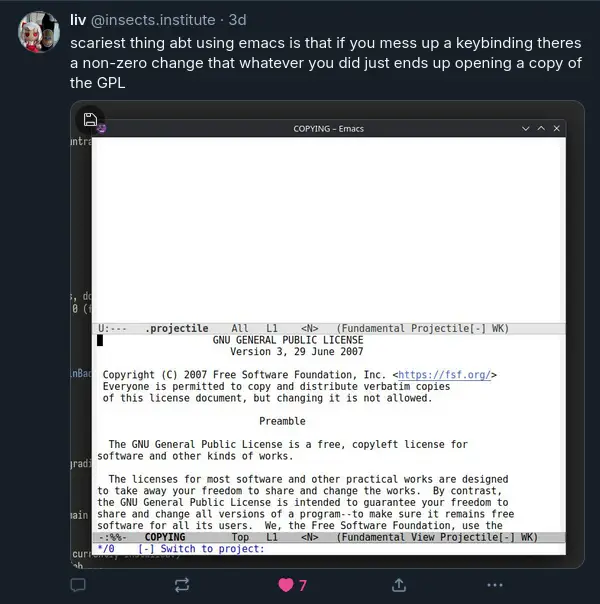
A ‘mode’ in emacs is a set of bindings which associate specific keys with specific functions.
Not quite, a mode is basically a lisp function defined with a different macro that integrates it into the various systems (like showing up in the modeline when active). It can do basically anything, including setting keybinds.
‘modes’ can be stacked on top of each other, with higher modes being able to intercept key presses before they reach lower modes, and changes / manipulate lower modes (I think?)
No, a keybind can only run one function and what that function is is whatever last defined a binding for that key. Like, if one mode defines a key to be something and you activate another that also binds that key, the latter takes over.
Emacs does have something like you describe, where functions can be ‘advised’.


Not really, Chrome has an overwhelming dominance on desktop despite not being preinstalled on any desktop operating system.


Interestingly, the person who added these to Bluesky say they’re a bad idea: https://blue.mackuba.eu/skythread/?author=hailey.at&post=3m2mldbsmys2t
Taler needs buy in from banks and irrc it’s only being trialled by some Swiss banks atm.